




Running a business means juggling countless decisions every single day. From sourcing supplies to managing budgets, procurement can quickly become overwhelming. Amazon Business changes that equation entirely. This B2B platform offers businesses of all sizes—from solo entrepreneurs to Fortune 100 corporations—a streamlined way to purchase everything they need, often with significant cost savings and efficiency gains.
Amazon Business isn’t just Amazon with a business account slapped on top. It’s a sophisticated procurement ecosystem built specifically for organizational buyers, complete with bulk pricing, approval workflows, analytics tools, and integration capabilities that traditional B2B suppliers struggle to match. Whether you’re a small business owner trying to cut costs or a procurement professional managing millions in annual spend, understanding how Amazon Business works can transform your purchasing operations.
This comprehensive guide explores everything you need to know about Amazon Business in 2025, from its core features and benefits to practical strategies for selling on the platform. We’ll examine how businesses leverage this marketplace, compare it to traditional procurement channels, and provide actionable insights to help you maximize value from this powerful platform.
Table of Contents
What is Amazon Business?
Amazon Business is Amazon’s dedicated B2B marketplace, launched in 2015 to serve organizational buyers. Think of it as a specialized version of Amazon.com designed specifically for business purchasing needs. The platform connects millions of business customers with hundreds of millions of products, from office supplies and industrial equipment to IT hardware and janitorial supplies.
According to Shelley Salomon, Global Vice President for Amazon Business, the platform provides “procurement tools and features that help businesses of all sizes streamline purchasing, control spending, and free up time to focus on what matters most.” This focus on operational efficiency distinguishes Amazon Business from consumer-focused e-commerce.

The platform has experienced remarkable growth since its inception. Doug Herrington, CEO of Amazon Worldwide Stores, notes that Amazon Business has become “one of the fastest-growing parts of Amazon” by “constantly innovating on behalf of business customers.” Today, 97 of the Fortune 100 companies actively use Amazon Business, alongside millions of small and medium-sized businesses worldwide.
Understanding what defines a successful business model is crucial when evaluating platforms like Amazon Business. For deeper insights into business fundamentals, this comprehensive guide explores different business types and organizational structures that thrive in today’s market.
How Amazon Business Works
Amazon Business operates on the same underlying infrastructure as Amazon.com but adds specialized features for organizational purchasing. Here’s how the platform functions:
Account Structure and User Management
Businesses create a verified Amazon Business account, which can support multiple users with different permission levels. This multi-user functionality allows companies to establish approval workflows, spending limits, and purchasing guidelines across their organization.
A procurement manager might grant individual employees permission to purchase office supplies up to $500 without approval, while requiring management sign-off for larger purchases. This flexibility helps businesses maintain spending control while empowering employees to get what they need quickly.
Product Selection and Pricing
The platform offers access to hundreds of millions of products across virtually every category imaginable. Pricing often includes quantity discounts that kick in automatically when purchasing in bulk. A business buying 50 laptop chargers receives a lower per-unit price than someone buying just one.
Many products display business-only pricing that’s lower than consumer pricing, reflecting the economies of scale that come with B2B transactions. Sellers can also offer custom quotes for high-volume orders through the Request for Quote (RFQ) feature.
Purchasing and Payment
Amazon Business supports various payment methods tailored to organizational needs, including credit lines, invoice terms, and purchase order systems. This flexibility accommodates how businesses actually operate, rather than forcing them to adapt to consumer payment models.
The platform integrates with existing procurement systems, allowing companies to pull purchasing data directly into their accounting software or enterprise resource planning (ERP) systems. This integration eliminates manual data entry and ensures accurate spend tracking.
Fulfillment and Delivery
Amazon leverages its massive global logistics network to deliver products quickly and reliably. Business Prime members receive free shipping on eligible orders, with delivery options ranging from same-day to scheduled bulk deliveries.
For businesses looking to scale their operations effectively, understanding procurement optimization is just one piece of the puzzle. This resource on business scaling provides strategic frameworks for sustainable growth.
Key Features That Set Amazon Business Apart
Several distinctive features make Amazon Business more than just “Amazon for companies”:
Business Prime Membership
Business Prime offers enhanced benefits tailored to organizational needs. Members receive free shipping on millions of items, access to exclusive deals, and tools like Guided Buying that help enforce purchasing policies. The membership scales with business size, offering different tiers for various organizational requirements.
Quantity Discounts
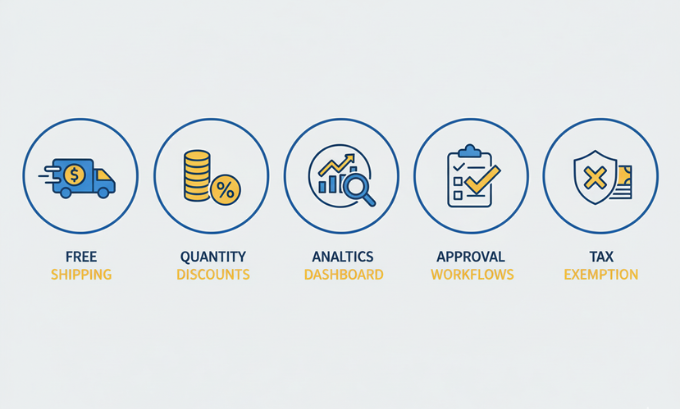
Bulk purchasing automatically triggers tiered pricing. Buy 10 items and pay one price; buy 100 and pay significantly less per unit. This transparent discount structure makes it easy to understand cost savings before committing to large orders.
Request for Quote (RFQ)
For high-volume purchases or custom requirements, the RFQ feature lets buyers submit detailed specifications and receive competitive quotes from multiple sellers. This process brings traditional B2B negotiation into the digital marketplace.
Approval Workflows
Administrators can establish multi-level approval processes that route purchase requests through appropriate channels based on amount, category, or other criteria. This governance structure prevents unauthorized spending while maintaining purchasing efficiency.
Business Analytics Dashboard
The analytics dashboard provides comprehensive visibility into spending patterns, helping businesses identify cost-saving opportunities and track budget utilization. Users can generate detailed reports by department, category, or time period.
Tax Exemption Support
Amazon Business accommodates tax-exempt purchasing for qualified organizations, streamlining a process that’s typically cumbersome in traditional procurement.
Integration Capabilities
The platform integrates with major procurement and accounting systems, including SAP Ariba, Coupa, and Oracle. These integrations create seamless data flow between Amazon Business and existing enterprise systems.
Effective digital marketing strategies can help businesses maximize their presence on platforms like Amazon Business. This guide to digital marketing covers essential tactics for reaching B2B customers online.
Who Benefits from Amazon Business?
Amazon Business serves a remarkably diverse customer base, from individual entrepreneurs to massive corporations. Here’s how different segments leverage the platform:
Small Businesses
Small business owners and entrepreneurs use Amazon Business to access wholesale pricing without minimum order requirements. A local coffee shop can purchase supplies at competitive prices without negotiating with multiple vendors or maintaining large inventory levels.
The platform eliminates the need for multiple supplier relationships, saving time and administrative overhead. Instead of managing accounts with ten different vendors, a small business can consolidate purchasing through a single platform with consistent terms and delivery.
Many small businesses also discover new products and suppliers they wouldn’t have found through traditional channels. The platform’s recommendation engine surfaces relevant products based on purchase history and business category.
For entrepreneurs exploring new ventures, identifying the right business model is critical. This collection of small business ideas offers inspiration for various industries and investment levels.

Medium-Sized Organizations
Mid-market companies benefit from Amazon Business’s scalability and control features. These organizations typically have more complex purchasing requirements than small businesses but lack the massive procurement departments of Fortune 500 companies.
The approval workflow capabilities help these businesses maintain spending control as they grow. A company with 50 employees can establish clear purchasing guidelines without hiring dedicated procurement staff.
Business Prime’s tiered membership options allow medium-sized organizations to select coverage levels that match their needs and budgets, paying for only the features they’ll actually use.
Large Enterprises and Fortune 100 Companies
Major corporations leverage Amazon Business’s integration capabilities to complement existing procurement systems. Rather than replacing established processes, Amazon Business extends them by providing a convenient channel for certain categories of spend.
Large organizations particularly value the platform’s data and analytics capabilities. With thousands of transactions flowing through various departments, the ability to aggregate and analyze spending patterns becomes crucial for strategic cost management.
The RFQ feature enables enterprises to negotiate custom pricing for high-volume purchases while maintaining the convenience of the Amazon platform. A manufacturing company might negotiate annual pricing for safety equipment while still using the platform for one-off purchases.
Government and Educational Institutions
Public sector organizations face unique procurement requirements, including competitive bidding rules and complex compliance requirements. Amazon Business accommodates these needs through specialized government purchasing programs and educational institution discounts.
Schools, universities, and government agencies can maintain required documentation and audit trails while accessing competitive pricing and fast delivery.
Regardless of organization size, setting clear business objectives drives success. This guide to goal setting provides frameworks for establishing and achieving strategic goals.
Business Prime: Premium Membership Benefits
Business Prime takes the standard Amazon Business experience and amplifies it with premium features designed for organizations with significant purchasing volume:
Free Shipping Benefits
Business Prime members receive free shipping on millions of eligible items with no minimum purchase requirements. For businesses making frequent small purchases, this benefit alone often justifies the membership cost.
The platform offers various delivery speed options, from standard shipping to same-day delivery in select areas. This flexibility lets businesses balance urgency with cost considerations.
Enhanced Business Analytics
Premium analytics tools provide deeper insights into spending patterns, supplier performance, and cost-saving opportunities. Members can create custom reports and set up automated alerts for budget thresholds or unusual purchasing patterns.
Guided Buying
This feature helps businesses enforce purchasing policies by directing employees toward preferred suppliers or products. If your company has negotiated special pricing with certain vendors, Guided Buying can steer users toward those options automatically.
Expanded User Licenses
Business Prime memberships include multiple user licenses, allowing organizations to provide accounts for all employees who need purchasing access. The number of included licenses scales with membership tier.
Priority Customer Support
Members receive access to dedicated business customer service representatives who understand organizational purchasing needs and can quickly resolve issues that might disrupt operations.
Exclusive Deals and Promotions
Business Prime members gain access to business-only deals and promotions not available to standard account holders. These exclusive offers can provide significant savings on frequently purchased items.
For businesses exploring cost-effective growth strategies, marketing doesn’t have to break the bank. This article on low-cost marketing ideas offers creative approaches for startups and small businesses.
Selling on Amazon Business
Amazon Business represents a significant opportunity for sellers looking to reach organizational buyers. The B2B marketplace operates alongside the consumer marketplace but with distinct dynamics:
Getting Started as a B2B Seller
Existing Amazon sellers can expand into Amazon Business by enabling business-only pricing and features within their seller account. New sellers need to complete the standard Amazon seller registration process and then activate B2B features.
The platform requires sellers to maintain high performance standards, including fast shipping, low defect rates, and responsive customer service. B2B buyers have less patience for delays or quality issues than consumer buyers.

Product Listings and Optimization
Creating effective product listings for business buyers differs from consumer-focused listings. B2B buyers want detailed specifications, compliance certifications, and bulk pricing information prominently displayed.
Product titles should include industry-standard terminology rather than consumer-friendly marketing language. A construction company searching for “ANSI-rated safety helmets” won’t find your listing if you’ve titled it “Cool hard hats for work.”
High-quality images remain important, but B2B listings benefit from technical drawings, dimension diagrams, and compliance documentation images. Business buyers often need to verify products meet specific requirements before purchasing.
Obtaining Product Identifiers
Most products sold on Amazon require unique product identifiers, typically Universal Product Codes (UPCs) or European Article Numbers (EANs). These barcodes help Amazon track inventory and ensure product authenticity.
Sellers can obtain legitimate UPCs through GS1, the official barcode issuer. While third-party barcode sellers offer cheaper alternatives, using non-GS1 barcodes can create problems with brand registry enrollment and listing verification.
For private label products, enrolling in Amazon Brand Registry provides additional control over listings and protection against counterfeiters. This program requires a registered trademark but offers significant benefits for serious sellers.
Pricing Strategies for B2B
Business buyers expect quantity discounts, so implementing tiered pricing is essential. Set discount thresholds that encourage larger orders while maintaining healthy margins.
Consider offering business-only pricing that’s lower than your consumer pricing but still profitable given the typically larger order sizes and lower return rates in B2B transactions.
The RFQ feature lets you negotiate custom pricing for high-volume buyers. While this requires more hands-on management, it can secure large accounts that provide steady revenue.
Fulfillment Options
Amazon offers two primary fulfillment approaches for business sellers:
Fulfillment by Amazon (FBA): Amazon stores your inventory, picks and packs orders, and handles shipping and customer service. This option maximizes your eligibility for Prime shipping and removes logistics headaches, but comes with storage and fulfillment fees.
Fulfillment by Merchant (FBM): You maintain your own inventory and handle shipping. This approach offers more control and potentially higher margins but requires more operational capacity.
Many B2B sellers use a hybrid approach, using FBA for smaller, high-velocity items while fulfilling large bulk orders directly to maintain control over custom delivery requirements.
Understanding Amazon’s FBA program thoroughly helps sellers make informed fulfillment decisions. This detailed guide to Amazon FBA explores the program’s benefits and considerations.
Navigating Compliance and Regulations
B2B sales often involve additional compliance requirements beyond consumer sales. Certain products require certifications, safety data sheets, or regulatory approvals before businesses can purchase them.
Sellers must ensure their products meet relevant industry standards and that all required documentation is available. A company selling industrial chemicals must provide Material Safety Data Sheets (MSDS); a seller of electrical equipment needs appropriate certification marks.
Amazon enforces strict policies on restricted products and requires sellers to provide documentation proving compliance before listing certain categories. Failure to maintain proper compliance can result in listing suspension or account deactivation.
For entrepreneurs considering various business models, e-commerce offers tremendous potential. This overview of e-commerce business ideas explores opportunities for beginners.
Amazon Business vs. Traditional B2B Procurement
How does Amazon Business compare to traditional procurement channels? Understanding the differences helps businesses determine when to use each approach:
Pricing and Cost Transparency
Traditional Procurement: Pricing often requires quotes and negotiations. Buyers may not know if they’re getting competitive pricing without comparing multiple vendors.
Amazon Business: Transparent pricing with visible quantity discounts. Buyers can instantly compare options from multiple sellers. However, for truly massive volumes, direct negotiation with manufacturers might still yield better pricing.
Product Selection and Availability
Traditional Procurement: Specialized distributors offer deep expertise in narrow categories but limited breadth. Finding a single vendor for diverse needs proves challenging.
Amazon Business: Massive breadth across categories, making it ideal for consolidating tail spend across many product types. However, highly specialized industrial products may not be available or may lack the depth of selection found at specialized distributors.
Speed and Convenience
Traditional Procurement: Ordering often involves multiple steps: requesting quotes, submitting purchase orders, waiting for processing. Emergency purchases create headaches.
Amazon Business: One-click ordering with delivery in days or even hours. The streamlined process dramatically reduces procurement cycle time for non-strategic purchases.
Relationship and Service
Traditional Procurement: Direct relationships with vendors provide personalized service, technical support, and flexibility for custom requirements.
Amazon Business: Standardized, efficient service that works well for routine purchases but may lack the personal touch valuable for complex needs or strategic relationships.
Integration and Data
Traditional Procurement: Each vendor has different systems, creating data fragmentation and integration challenges.
Amazon Business: Single platform with robust integration capabilities and unified data, simplifying spend analysis and system integration.
Strategic Value
Traditional Procurement: Direct vendor relationships enable strategic partnerships, joint innovation, and preferential treatment during supply shortages.
Amazon Business: Transactional marketplace model limits strategic partnership opportunities but excels at efficient tactical purchasing.
The optimal approach often involves using Amazon Business for tail spend and routine purchases while maintaining strategic relationships with key suppliers for critical categories.
Successful businesses employ multiple strategies to optimize operations. This resource on business scaling examines how organizations grow sustainably.
Getting Started with Amazon Business
Ready to leverage Amazon Business? Here’s your step-by-step roadmap:
Step 1: Create Your Business Account
Visit the Amazon Business homepage and click “Create a free account.” You’ll need basic business information including your tax identification number and business address.
Amazon verifies business accounts to ensure legitimacy and enable features like tax-exempt purchasing. This verification typically takes one to two business days.
Step 2: Set Up User Accounts and Permissions
Add team members who need purchasing access. Assign appropriate permission levels based on roles—some users might have unlimited purchasing authority while others require approval for purchases above certain amounts.
Establish approval workflows that match your organization’s governance requirements. A small business might use simple spending limits, while larger organizations may implement multi-level approval chains based on amount and category.
Step 3: Configure Payment Methods
Add payment methods appropriate for your business. Options include credit cards, debit cards, or applying for an Amazon Business Line of Credit for invoice terms.
Set default payment methods for different users or departments to ensure proper budget allocation and accounting.
Step 4: Establish Purchasing Policies
Use Guided Buying to create policies that direct employees toward preferred products or suppliers. If your company has negotiated special pricing with certain vendors, configure the system to promote those options.
Set spending limits by user, department, or product category to maintain budget control while enabling purchasing autonomy.
Step 5: Integrate with Existing Systems
If your organization uses procurement or accounting software, explore available integrations. Connecting Amazon Business with your ERP system eliminates manual data entry and ensures accurate spend tracking.
Amazon provides integration guides and support for major enterprise systems including SAP, Oracle, and Coupa.
Step 6: Consider Business Prime Membership
Evaluate whether Business Prime makes sense for your purchasing volume. The membership pays for itself quickly if your organization makes frequent purchases that would otherwise incur shipping charges.
Use the Business Prime calculator tool to estimate potential savings based on your expected purchasing patterns.
Step 7: Train Your Team
Ensure employees understand how to use the platform effectively. Cover topics like finding products, comparing options, following purchasing policies, and tracking orders.
Amazon offers training resources and webinars to help organizations maximize platform value.
For businesses just starting their journey, understanding core concepts is crucial. This beginner’s guide to business covers fundamental principles every entrepreneur should know.
Sustainability and Social Responsibility
Amazon Business increasingly emphasizes sustainability and responsible business practices:
Environmental Initiatives
The platform offers tools to help businesses reduce their environmental footprint. Companies can track packaging waste and delivery-related emissions through sustainability dashboards.
Amazon’s Climate Pledge Friendly program highlights products that meet sustainability certifications, making it easier for businesses to prioritize environmentally responsible purchasing.
Businesses can opt for pallet delivery options that consolidate multiple orders into fewer shipments, reducing delivery trips and associated emissions. This approach particularly benefits organizations making large, regular purchases.
Ethical Sourcing and Diversity
Amazon Business provides data about supplier diversity, helping companies meet diversity spending goals. The platform identifies products from minority-owned, women-owned, and small businesses.
Ethical sourcing information helps buyers make informed decisions aligned with corporate social responsibility commitments.
Long-Term Value Creation
The platform’s emphasis on efficiency and waste reduction aligns with sustainable business practices. By optimizing procurement processes and reducing unnecessary purchasing, businesses simultaneously cut costs and minimize resource consumption.
Understanding digital transformation helps businesses integrate sustainable practices effectively. This guide to digital transformation strategies explores how technology drives modern business evolution.
Common Questions About Amazon Business
How much does Amazon Business cost?
Creating an Amazon Business account is free. Business Prime membership costs vary based on organization size and features selected, with pricing tiers designed for small businesses, medium-sized organizations, and large enterprises.
Can I use my personal Amazon account for business purchases?
While technically possible, using a dedicated Amazon Business account provides significant advantages including business-only pricing, quantity discounts, tax exemption support, and organizational purchasing controls that personal accounts lack.
What’s the difference between Amazon Business and regular Amazon?
Amazon Business adds B2B-specific features including quantity discounts, approval workflows, business analytics, tax exemption capabilities, and integration with procurement systems. Product selection largely overlaps but includes business-only items not available on the consumer site.
How do I get tax-exempt status on Amazon Business?
Qualified organizations can submit tax exemption certificates through their Amazon Business account settings. Amazon verifies the documentation and applies tax exemption to eligible purchases once approved.
Can I negotiate pricing on Amazon Business?
For high-volume purchases, the Request for Quote (RFQ) feature enables price negotiation with sellers. Standard catalog purchases follow listed pricing, but quantity discounts apply automatically based on order size.
What payment terms does Amazon Business offer?
Payment options include standard credit/debit cards, Amazon Business Line of Credit with net terms, and integration with procurement card programs. Approved businesses can receive invoice terms that defer payment.
Does Amazon Business work internationally?
Amazon Business operates in multiple countries including the United States, United Kingdom, Germany, France, Italy, Spain, Japan, and India. International businesses can purchase from their local Amazon Business marketplace.
How secure is Amazon Business for sensitive purchases?
Amazon employs enterprise-grade security including encryption, secure payment processing, and data privacy controls. The platform complies with relevant security standards and regulations for B2B transactions.
Entrepreneurs exploring diverse opportunities will find inspiration in this collection of small business ideas covering various industries and investment levels.
The Future of B2B Commerce
Amazon Business represents more than just another purchasing channel—it embodies the transformation of B2B commerce from relationship-driven, phone-and-fax transactions to data-driven, digital experiences that mirror consumer e-commerce convenience.
Several trends will shape the platform’s evolution:
AI-Powered Procurement: Amazon’s investment in AI technology will increasingly personalize the buying experience, automatically suggesting relevant products, identifying cost-saving opportunities, and streamlining purchasing workflows.
Enhanced Integration: Deeper connections between Amazon Business and enterprise systems will eliminate remaining friction points, eventually enabling fully automated purchasing for routine items based on inventory levels or usage patterns.
Marketplace Expansion: The platform will continue attracting more sellers and expanding product selection, particularly in specialized B2B categories currently underserved.
Sustainability Focus: Environmental considerations will play a growing role in purchasing decisions, with expanded tools to help businesses measure and reduce the carbon footprint of their procurement activities.
Global Reach: As Amazon Business expands into more countries, multinational organizations will increasingly use the platform for standardized global procurement, leveraging consistent pricing and policies across regions.
For businesses ready to take the next step, launching an online presence opens new opportunities. This guide to starting a business provides practical steps for aspiring entrepreneurs.
Take Action: Transform Your Procurement Strategy
Amazon Business has fundamentally changed how organizations purchase the supplies and equipment they need to operate. By combining massive selection, transparent pricing, powerful analytics, and seamless delivery, the platform delivers value that traditional procurement channels struggle to match.
Whether you’re a small business owner looking to cut costs and save time, a procurement professional seeking to optimize organizational spending, or an entrepreneur wanting to reach B2B customers, Amazon Business offers tools and opportunities worth exploring.
The key to success lies in understanding the platform’s capabilities and strategically integrating them into your broader procurement or sales strategy. Amazon Business works best when used thoughtfully—as a complement to existing approaches rather than a wholesale replacement.
Start by assessing your current situation. Small businesses might immediately consolidate supplier relationships and gain access to better pricing. Medium-sized organizations could implement approval workflows and analytics to gain spending visibility. Large enterprises might focus on integration capabilities and supplier diversity goals.
For sellers, success requires understanding B2B buyer expectations and optimizing listings, pricing, and fulfillment accordingly. The opportunity is substantial, but the competition is fierce.
Whatever your role, the time to engage with Amazon Business is now. As the platform continues growing and evolving, early adopters gain experience and advantages that compound over time. Take the first step today—create an account, explore the features, and discover how Amazon Business can support your goals.
